

Insurance for Farmers
Weather Insurance for Farmers
Weather-indexed insurance for smallholder farmers in India
When rainfall impacts your crop yields, triggering droughts or flooding your field, get insurance payout transferred directly to your account with weather-indexed insurance for smallholder farmers.
How Smallholder Farmers Lose Seasons to Climate Risk
When droughts or extreme rainfall destroy crops, farmers lose an entire season’s income while loans, input costs, and household expenses continue without relief.
02
Traditional Insurance Moves Too Slowly
Conventional crop insurance relies on crop-cutting assessments and delayed settlement processes. Most smallholder farmers receive payouts long after the season’s financial damage has already occurred.
01
Seasonal Income Can Collapse
A failed kharif or rabi season can erase a farmer’s yearly earnings. Yet fertiliser costs, labour payments, input loans, and household expenses continue accumulating regardless of crop performance.
03
Climate Variability Keeps Rising
Erratic monsoons, prolonged heatwaves, and unpredictable rainfall patterns are making farming seasons harder to predict. Smallholder farmers now face growing climate risks without dependable financial protection.
Where Traditional Crop Insurance Falls Short: The Smallholder Protection Gap
Traditional crop insurance products are designed around crop-cutting experiments, area-level yield assessments, and long settlement cycles that rarely reflect the realities of smallholder farming. Farmers facing droughts, excess rainfall, or heat stress often wait months for compensation while loans, input costs, and household expenses continue accumulating. Parametric weather index insurance changes the model entirely by using objective weather data as the trigger.
When rainfall deficits, heatwaves, or excess rain cross the defined threshold at a farmer’s PIN code and are verified by IMD or ERA5 data, the payout is released automatically without field visits, crop-cutting experiments, or delayed yield assessments.
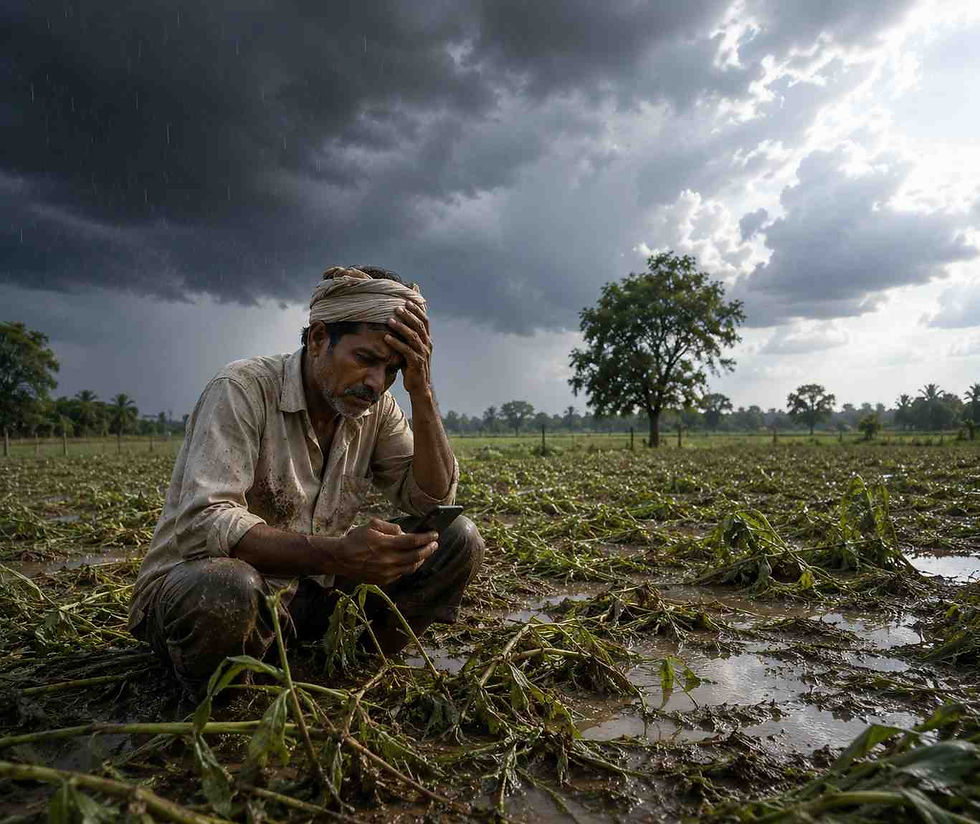


Why Traditional Crop Insurance Fails Smallholder Farmers in Weather Events
Traditional crop insurance depends on crop-cutting experiments and area-average yield calculations that often fail to reflect individual farm-level losses. Farmers also face long settlement delays, disputes over assessments, and dependence on crop loans or land records to access coverage.
Additionally, many tenant farmers and unbanked cultivators are excluded entirely from formal insurance systems. Premium deductions may happen automatically through loans, but payouts still require lengthy follow-up and documentation that many farmers cannot realistically pursue.
Plutas’ parametric weather index insurance for smallholder farmers eliminates these gaps with objective IMD and ERA5 data, automatic payouts, zero documentation, no adjusters, and hyperlocal PIN-code pricing.
How It Works
Weather Insurance in Just 10 Minutes
01
Setup: Enter PIN code & peril
Tell Plutas where your farm is located and which weather risk concerns you most. You can stack multiple perils on the same PIN code across different crop phases.
02
Pricing: Set coverage & trigger
Choose the crop stage you want to cover, from sowing to harvest. Set your Strike Point and insured amount based on your expected seasonal input costs and weather exposure.
03
Issue: Set insured sum & pay
Size your policy and pay digitally using UPI, net banking, or cards. Your certificate is issued instantly with no agent visit, paperwork, or office appointment required.
04
Payout: Funds credited
IMD and ERA5 data are continuously monitored at your farm’s PIN code. The payout is transferred directly to your registered bank account or UPI once validated.
What’s Covered
Every Weather Event That Destroys a Farming Season
Each smallholder farmer weather insurance policy is triggered by objective, government-verified data from the India Meteorological Department (IMD) or ERA5 reanalysis. The trigger is defined at the time of purchase. If the data crosses your threshold at your farm’s PIN code during the covered crop phase, you are paid. No ambiguity. No negotiation.
You can buy drought insurance cover for a single crop stage, a full monsoon season, or multiple weather risks across the same crop cycle. Your policy is priced at your farm’s PIN code, not a district average.
Weather Peril | Trigger Definition | Data Source |
|---|---|---|
Drought / Rainfall Deficit | Cumulative rainfall at your farm PIN code falls below your Strike Point (mm) during a defined crop phase window (the threshold at which soil moisture becomes insufficient for crop development and yield stability) | IMD |
Excess Rainfall / Flash Flood | Rainfall at your farm PIN code exceeds your selected threshold (mm/24 hrs or mm/phase), causing waterlogging, root damage, flooding, or post-harvest crop loss | IMD |
Heatwave During Critical Growth Stage | Daily maximum temperature at your farm PIN code exceeds your Strike Point (°C) for consecutive days during heat-sensitive crop stages such as flowering, grain fill, or tasselling | ERA5 |
Delayed Monsoon Onset | Monsoon arrival at your farm PIN code is delayed beyond the defined threshold, disrupting sowing schedules, crop calendars, and seasonal productivity | IMD |
Dry Spell Within Season | A consecutive-day period during the growing season records rainfall below the minimum threshold (mm), creating damaging intra-season drought conditions despite seasonal rainfall totals | IMD |
Cold Wave (Rabi Crops) | Minimum temperature at your farm PIN code falls below your defined threshold (°C) for a sustained period, damaging rabi crops during flowering or grain-fill stages | ERA5 |
Use Cases
See How Parametric Insurance Protects
Different Farmers
Rainfed Kharif Farmers
Rainfed farmers face severe crop losses from droughts and excess rainfall during sowing, flowering, and harvest stages. Parametric weather insurance triggers automatic payouts based on verified rainfall conditions at the farm’s PIN code.
Tenant Farmers & Sharecroppers
Tenant cultivators and sharecroppers often remain excluded from traditional crop insurance due to missing land records or crop loans. Parametric weather insurance provides direct protection using PIN-code-based weather triggers instead of ownership documents.
Cotton & Pulses Farmers
Cotton and pulses farmers face dry spells, excess rainfall, and flowering-stage weather disruptions that sharply reduce yields and crop quality. Parametric weather insurance helps cover input costs through automatic weather-triggered payouts.
Horticulture & Vegetable Farmers
Labour contractors face dual exposure during weather shutdowns: idle workers still require payment while site productivity stops entirely. Parametric weather insurance helps cover worker wage liabilities and income disruption during heatwaves or rainfall suspensions.
Know Your Risk. Price Your Cover.
Plutas does not give smallholder farmers a blanket district-level premium. Our AI model calculates the precise probability of your specific trigger event at your farm’s PIN code, your crop phase window, and the sum insured that matches your input cost exposure. You pay only for the weather risk your crop actually faces during the phase it actually faces it.
We analyse 30+ years of historical IMD and ERA5 weather data for your farm’s PIN code. The premium adjusts in real time as you move the trigger threshold or crop phase window. You can stack drought, rainfall, and heat cover simultaneously across different crop stages.
Parametric weather index insurance for smallholder farmers starts from ₹600 per phase — no annual commitment, no minimum policy period, and no crop loan required.
FAQs
Still Deciding? Get the Answers to Your Questions

Still have questions?
Talk to our climate insurance experts and find the right protection for your business, property, or operations.
Construction worker weather insurance is a parametric policy that provides income protection for outdoor workers when weather conditions, typically heatwaves or hazardous rainfall, prevent safe work at the site. The policy can be structured at the site contractor level (covering the employer’s wage liability during suspensions) or at the individual worker level (paying a daily sum directly to enrolled workers during weather shutdowns). The trigger is set by IMD or ERA5 data at the site PIN code.
Parametric construction weather insurance is sized to cover operational downtime costs, not physical damage. The sum insured can be calculated to reflect your daily labour wage burden, equipment standby rate, and estimated penalty clause exposure per weather shutdown day. Because the payout is automatic and arrives within ~24 hours of trigger validation, it provides working capital to cover those obligations before the project’s cash flow is strained.
Yes. Plutas parametric construction weather insurance is fully modular. Coverage windows range from single to multiple days, allowing you to buy cover for a critical phase, a foundation pour, a peak monsoon window, or a coastal handover sprint, without committing to an annual product that includes seasons when your project risk is minimal.
No. Plutas parametric construction weather insurance is a complement to your existing CAR policy, not a replacement. CAR insurance covers physical damage to works, plant, and equipment. Parametric weather insurance covers the financial cost of weather-forced operational downtime, idle labour, equipment standby, and delay penalties. It can also cover the loss of pay for workers due to extreme weather events.
Qualified & Certified
Smart Weather Insurance for Farming Communities
Built for cultivators, tenant farmers, and agricultural workers, this parametric insurance solution combines weather intelligence, climate analytics, and risk expertise to provide fast and transparent protection against climate-driven crop and income disruptions.
Real-Time Weather Risk Monitoring
Automatic Weather-Based Payouts
Fast Cash Flow for Crop Disruptions
Smallholder farm
Households exposed to weather income risk in India
100M+
Payout
After trigger validation; no paperwork needed
~24 hrs
Minimum cover
Amount to pay per crop phase in India
₹600
PIN codes
Policy issued in under 10 minutes
19K+
Why Choose
Parametric Weather Insurance with Plutas
Most traditional crop insurance products are built around crop loans, land records, and delayed crop-cutting assessments. Parametric insurance addresses the protection gap for smallholder and tenant farmers.
Traditional crop insurance | Parametric weather index insurance |
|---|---|
Requires crop loan accounts or land records, excluding many tenant farmers and informal cultivators | No crop loan or land ownership proof required; your farm PIN code and bank account are sufficient |
Crop-cutting experiments and yield assessments delay payouts for months after harvest | Payout is released in ~24 hours once the weather trigger is validated |
Losses assessed at the block or taluka level, ignoring individual farm-level damage | Trigger assessed at your exact farm PIN code, unique to your location and weather |
Farmers must actively follow up on claims and settlement processing | Fully automatic payout triggered by IMD and ERA5 weather data |
Disputes over crop-cutting methods and yield calculations are common | Fully objective; if the IMD or ERA5 data crosses the threshold, you are paid |
Annual bundled products force coverage across crops and seasons, and farmers may not need | Modular coverage aligned to specific crop phases, weather windows, and perils only |
Payouts based on area-average losses can underpay farmers facing severe localised damage | Payout based entirely on weather conditions at your farm’s PIN code |