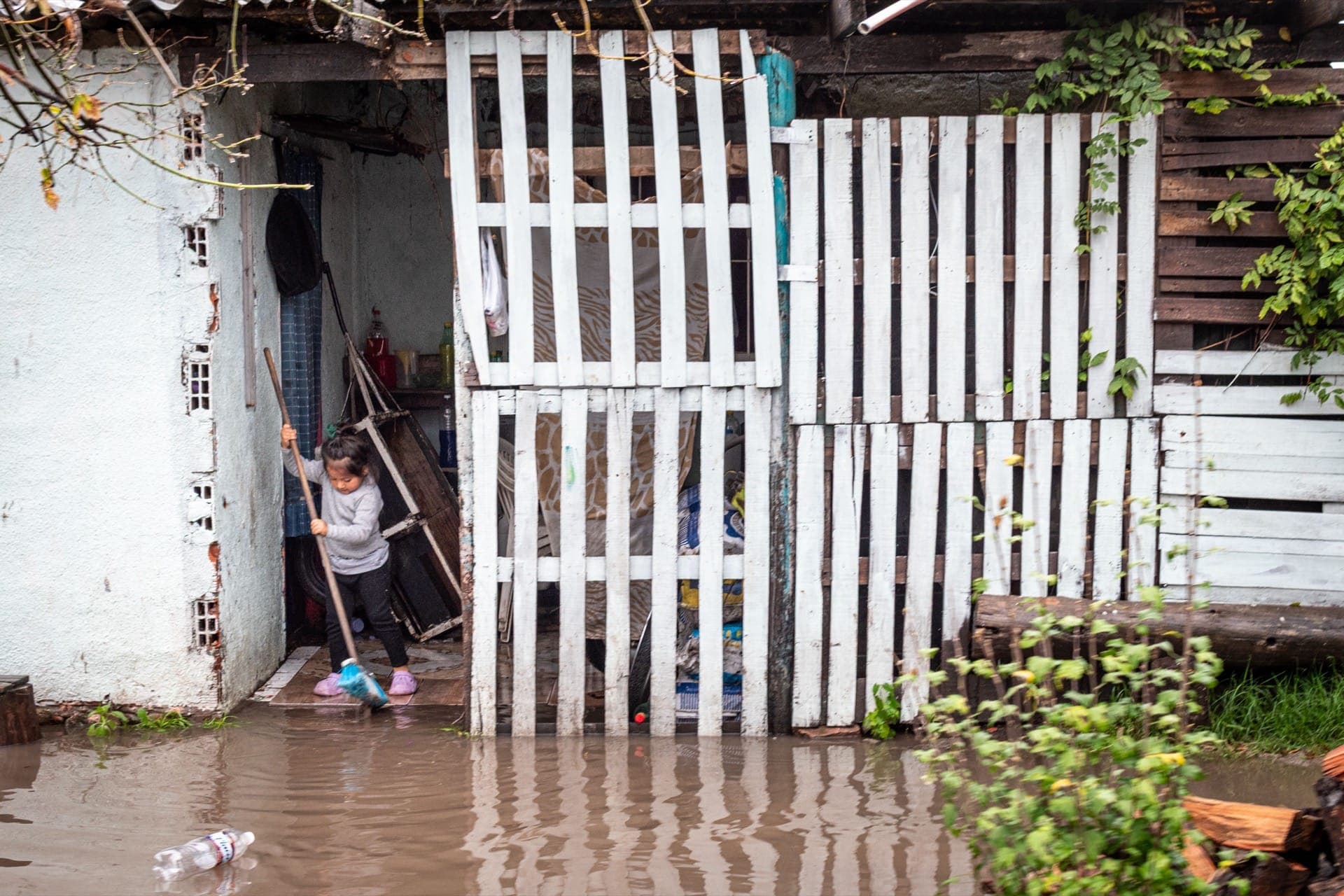
The Flood That Cost More After It Left: Why Affordable Home Flood Insurance Is a Necessity, Not a Privilege
Extreme weather destroyed at least 181,459 houses across India between January and November 2025.
Over the past two decades, floods alone have accounted for 67% of India's natural-disaster economic losses.
But the financial impact of a flood does not end when the water recedes.
For a family whose home has been damaged, the real crisis may begin afterward.
There are repairs to pay for, appliances to replace, temporary accommodation to arrange, and household expenses to continue meeting.
Without insurance or adequate savings, these costs can turn a few days of flooding into years of financial pressure.
That is why affordable home flood insurance is becoming less of a luxury and more of a financial resilience tool.
Flood damage can leave families with repair bills, temporary housing costs, and lost belongings long after the water recedes. Affordable flood insurance can speed recovery.
Written byReecha SinhaVice President

Why the Protection Gap Is a Housing Problem
Across emerging economies, approximately 80–90% of catastrophe losses remain uninsured.
India has an especially significant protection gap. Swiss Re has estimated that around 93% of India's climate-related losses are uninsured.
This is not simply an awareness problem.
Affordability, product complexity, and accessibility all contribute to the gap.
Traditional home insurance can require property valuation, documentation, and a premium based on the declared value of the property.
For lower- and middle-income households, that can make comprehensive protection feel difficult to access.
The problem is particularly significant because climate exposure and financial vulnerability often overlap.
Low-lying neighbourhoods, river-adjacent settlements, and rapidly urbanising areas with inadequate drainage can experience repeated flooding.
These are also areas where many households have limited savings to absorb a large unexpected expense.
The result is a difficult equation:
Higher flood exposure + Lower financial buffers = Greater household vulnerability
Urban flooding alone has been estimated to cost India approximately $4 billion annually, with losses expected to increase significantly as urbanisation and climate risks intensify.
For households without adequate insurance, much of that cost becomes a personal financial burden.
What Traditional Home Flood Insurance Covers
India does have a standardised home insurance framework that includes protection against natural catastrophes.
The Bharat Griha Raksha (BGR) policy was introduced under IRDAI's standardisation framework for general insurers from April 2021.
The policy provides cover for residential buildings and contents against specified perils, including events such as floods, storms, and cyclones, subject to the terms and conditions of the policy.
The challenge is not necessarily the existence of cover.
It is the claims process.
Following a flood, a conventional insurance claim can involve:
- Filing the claim.
- Providing supporting documentation.
- Survey and damage assessment.
- Insurer review.
- Claim approval.
- Settlement.
That process is designed to determine the actual financial loss.
But the household's financial needs do not wait for the assessment.
A family displaced from its home may need money immediately for temporary accommodation, food, transport, repairs, and replacement essentials.
This creates an important distinction between coverage and liquidity.
Insurance can cover the loss.
But the timing of the payout determines how quickly the household can begin recovering.
How Flood Parametric Insurance Changes the Timing of Help
Flood parametric insurance approaches the problem differently.
Instead of assessing the actual damage to each property after an event, the policy establishes a measurable trigger before the coverage period begins.
For example:
If rainfall at a specified weather station exceeds a predefined threshold within 24 hours, a fixed payout is triggered.
The mechanism is straightforward:
Extreme weather event → Trigger verified → Predefined payout
There is no requirement to determine the precise rupee value of damage before the trigger can be activated.
This can significantly simplify the claims process.
It also makes parametric insurance potentially useful as natural disaster financial protection for households that need immediate liquidity following a climate event.
Because the product relies on an objective trigger rather than individual damage assessment, administrative complexity can be reduced.
That creates the potential for simpler and more accessible products, although affordability ultimately depends on the product's design, risk profile, distribution costs, and pricing.
What Affordable Flood Cover Means in Practice
Consider a family living in a flood-prone area of Patna.
Following an extreme rainfall event, the family may face several expenses at once:
- Temporary accommodation
- Damaged furniture
- Replacement appliances
- Cleaning and restoration
- Electrical repairs
- Contractor deposits
- Lost household items
Under a traditional home insurance claim, the family may need to document the damage and wait for assessment and settlement.
With a suitably designed flood parametric insurance product, a qualifying weather trigger could activate a predefined payout without requiring the family to establish the precise value of every loss.
The practical difference is timing.
Cash before the repair queue
A quick payout can help a family arrange temporary accommodation, pay contractors, or replace essential household items while recovery is underway.
Less documentation during a crisis
A household dealing with displacement and damaged property does not have to make an extensive loss-assessment process the immediate priority.
Certainty about the payout
The payout amount is defined when the policy is purchased.
There is less uncertainty about what the policy will pay once the trigger condition is verified.
This is the core value proposition of microinsurance for climate shocks.
The objective is not necessarily to replace every form of conventional insurance.
It is to make some level of financial protection accessible and responsive to households that may otherwise remain uninsured.
Where Flood Parametric Insurance Has Limits
Parametric insurance is fast and simple by design.
But those advantages come with trade-offs.
Fixed Payout Versus Actual Damage
A parametric policy pays a predetermined amount when the trigger is met.
It does not necessarily compensate the policyholder for the exact amount of damage.
Suppose a family experiences ₹2 lakh of damage but the policy pays ₹50,000.
The payout provides useful liquidity, but it does not make the household financially whole.
Traditional indemnity insurance is designed differently: it attempts to compensate for covered losses subject to the policy's terms, limits, deductibles, and exclusions.
This means parametric insurance should not automatically be viewed as a complete replacement for conventional property insurance.
Basis Risk: When the Index and Reality Differ
The second major limitation is basis risk.
The trigger relies on a predefined weather measurement.
But weather conditions can vary significantly across short distances.
For example, a monitoring station may record rainfall below the trigger threshold even though a particular neighbourhood floods because of:
- A blocked drainage system
- River overflow
- Localised cloudbursts
- Poor urban drainage
- Water accumulation from surrounding areas
If the policy's trigger is not met, no parametric payout may be generated—even if the household experiences genuine flood damage.
The reverse can also happen.
The trigger may be breached even though a particular property experiences relatively limited damage.
This is why trigger design and data selection are critical to affordable home flood insurance.
How to Use Parametric and Traditional Cover Together
The most practical approach for many households may not be choosing between traditional and parametric insurance.
It may be combining their strengths.
Traditional home insurance can provide broader protection against covered property losses.
Parametric insurance can provide rapid liquidity following a predefined weather event.
Together, they can serve different purposes:
| Protection | Traditional Home Insurance | Parametric Flood Insurance |
|---|---|---|
| Basis of payout | Assessed covered loss | Predefined weather trigger |
| Damage assessment | Generally required | Generally not required |
| Payout amount | Based on covered loss and policy terms | Fixed in advance |
| Speed | Can take time | Potentially faster after trigger verification |
| Basis risk | Lower in relation to covered physical damage | Higher because index may not match local loss |
| Best use | Broad property protection | Rapid post-event liquidity |
The right combination depends on the household's risk exposure, budget, policy terms, and available products.
What Should Homeowners Check Before Buying?
Anyone considering home flood insurance should understand exactly how the policy responds to a flood.
Key questions include:
Does the policy actually cover floods?
Not every home insurance product provides identical coverage. Check the covered perils and exclusions.
What triggers the payout?
For a parametric policy, understand the exact rainfall, flood-level, or other weather threshold.
Where is the weather measured?
A station several kilometres away may not accurately represent conditions at your home.
How much will the policy pay?
Understand the fixed payout or maximum insured amount before purchasing.
How quickly will the money arrive?
Check the conditions that must be met before a payout is released.
What happens if my home floods but the trigger is not met?
This is the most important basis-risk question for a parametric product.
A homeowner should understand this limitation before relying on parametric cover as their primary protection.
Why Affordable Flood Protection Matters
The purpose of insurance is not simply to compensate people after something goes wrong.
It is to prevent a shock from becoming a long-term financial crisis.
For a high-income household with substantial savings, a ₹1 lakh repair bill may be manageable.
For a family with limited savings, the same expense can mean:
Borrowing → higher interest costs → delayed repairs → reduced household spending → longer financial recovery
Affordable climate insurance can interrupt that cycle by putting cash into the household when it is needed most.
That is particularly important as extreme rainfall and urban flooding become more financially significant risks.
Microinsurance for climate shocks therefore has an important role to play alongside conventional insurance, government relief, and household savings.
Wrapping Up: Flood Protection Should Not Be a Luxury
Flood risk is not randomly distributed across India.
It concentrates in specific locations and disproportionately affects households that may have limited financial capacity to absorb repeated shocks.
The result is a persistent protection gap.
Affordable home flood insurance can help close part of that gap.
Traditional insurance provides broader protection based on actual covered losses.
Parametric insurance can provide rapid liquidity when predefined weather conditions occur.
Neither approach is perfect.
But together, they represent a more resilient way to think about household protection in a climate where extreme rainfall is becoming an increasingly important financial risk.
The goal should not be to wait for disaster relief after every major flood.
It should be to ensure that households have some form of financial protection before the water arrives.
Ready to Check Your Flood Cover?
Start by checking whether your home insurance currently covers floods and other relevant natural disasters.
If you live in a flood-prone area, also explore whether flood parametric insurance or microinsurance for climate shocks is available for your location.
Compare the trigger, coverage, payout amount, premium, exclusions, and basis-risk implications before purchasing.
Floods may be impossible to prevent.
But the financial damage they leave behind can be made easier to recover from.
00 Comments
Start the conversation
Be the first reader to share a thoughtful response.
Leave a Reply
Your email address will not be published. All comments are reviewed before appearing publicly.